Thinking About Feedback

During my tenure as the coach at Ohio State University, I recall sitting in the video room with Danielle Meyer Greaves, an absolute standout for our team. We were reviewing a video of practice on some aspect of her game, and she remarked, “I had no idea I was doing that.” This was after countless verbal reminders on my part about what she needed to focus on. It became very apparent that other forms of feedback that exist outside verbal cues can have a significant impact on players. It also stoked my passion for video analysis as a primary method of feedback and communication.
Even though most coaches agree that feedback is essential for individual and team development, we don’t spend much time exploring available feedback options and how we might use this teaching tool creatively. Coaches tend to rely solely on verbal feedback, but one could argue that verbal communication is not the most reliable form of feedback. Words can be easily misconstrued. Experimenting with new feedback methods merely requires the coach to possess an adventurous spirit and a willingness to try new things.
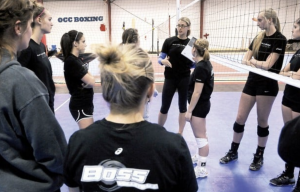
There are many types of feedback available to the coach and athlete. The low-hanging fruit would be verbal feedback, statistical, kinesthetic, visual, written, win/lose, ball result (good or bad pass), and the coach’s body language. There isn’t a singular “best” feedback tool. I recommend that coaches implement various feedback forms with players and teams to find what resonates and fosters improvement.
Along with being willing to try various forms of feedback, we should consider whether our current methods impact the athlete as we hope. Below are a few perspectives on feedback that might be considered when working with your team.
Is Positive Feedback the Most Effective?
We’ve appropriately accepted the benefits of positive feedback. We all want the athletes to enjoy the learning process, and coaches want the gym atmosphere to be upbeat. However, coaches must be cautious about compromising the learning process and skill development under the guise of positivity. Coaches can be hesitant to point out flaws in skill or team play due to not wanting to impact the positive vibes in their gym or might be concerned about how a player will respond to a critique. It is essential to understand that the opposite of positive feedback does not need to be negative feedback. A type of feedback called constructive critique (feedback) is worth implementing into your coaching routine. An AI search found data from a study comparing improvement when the student received positive feedback only, constructive feedback only, or a combination of both. I’ll define constructive feedback as targeting specific actions in techniques or skill execution that need improvement and providing a path forward. Constructive feedback does not translate to negative feedback.

Combining positive and constructive feedback resulted in the best improvement. Although this study originated in a classroom, would the results be similar on your practice court? My gut says yes!
The Feedback Sandwich
We’ve all heard of a feedback sandwich. When presenting a critique to a student, a feedback sandwich is when the teacher or coach imparts a positive comment first, then the critique, and finishes with a positive comment. The sandwich method of wrapping a critique with positives has become the standard for performance feedback. The rationale is that providing both positive and negative feedback reduces the student’s discomfort and anxiety.
However, is the Feedback Sandwich the best way to provide feedback? Author Kim Scott offers a different opinion in the best-selling book Radical Candor. Scott feels that using the feedback sandwich to impart a critique will blur the message and confuse the student. She recommends that a coach immediately get to the point, impart the critique, and present a path forward for improvement. I would emphasize the coach is critiquing the behavior, not the person.
Will a feedback sandwich work for some players? You can judge that on your own. However, when I praise an athlete, I prefer that the praise stand on its merits and not be attached to a critique. I don’t want the athlete who receives positive comments to be waiting for a critique to follow.
Know Your Audience
Not every athlete or team is the same, so different feedback forms might be in order. Let’s create a scenario. A USA National Team player is participating in a 6v6 drill emphasizing blocking and defensive court position. At the same time, a squad of 15-year-old players is performing the same drill on a different court. Will there be a difference in how feedback might be provided to the players on each court?
The national team athletes have been playing and receiving coaching for many years and have a foundation of knowledge of how to perform the skills, make the appropriate defensive reads, and problem-solve situations. They can focus on specific game aspects to perfect their exceptional skill set. To a large degree, they can see a problem, self-correct, and successfully arrive at a solution. Constant on-court feedback from a coach may not have an impact on performance. These elite athletes might find post-practice feedback (video or statistics) more valuable to refine a skill.

However, younger players lack the foundation of skill or knowledge that allows them to problem-solve or self-correct with any level of proficiency. They would require more immediate feedback from the coach to assist in error identification and correction. Learning a skill or solving a problem without prior knowledge would be challenging for a younger player. In other words, motor learning begins with cognitive knowledge. (Schmidt and Lee, 2005). The coach should supply some form of a road map for the athlete relative to skill acquisition and performance.
Is More Feedback Better?
This is a balancing act for coaches, who must be very aware of the amount and nature of the feedback provided. Feedback considered excessive for one player might be considered insufficient for another. A study at the University of Michigan indicated that feedback positively impacted performance. However, there was a reduced level of improvement when too much feedback was provided (feedback overload.) The coach must be cautious because providing too much information will result in their players drinking out of an “informational firehose.” In my experience, when a player seeks feedback, it increases the chance that the feedback you provide will positively impact performance.
Try Q & A
A different strategy worth trying is that instead of the coach providing all the answers and bombarding the player with verbal feedback, they might pose questions to the player. For example, “What did you see?” or “How was your defensive court position?” allowing the player to asses their execution and provide feedback to themselves. Along with a new way of providing feedback, this increases the ability of the player to evaluate and problem-solve in real time.
Video Feedback

One of the most underutilized forms of feedback is watching performances using post-event or live video. I prefer Dartfish software, but there are plenty of quality platforms available. A cautionary note: With inexperienced players, the coach should accompany the athlete when observing performance video. With limited knowledge, the athlete may not focus on the key aspects of the performance, thus missing valuable feedback. Video can supply the athlete with an objective look at performance, and the coach can supply the keys for improvement or a pat on the back for progress. It is not unusual for athletes to be overly critical of their skills or oblivious to improvement. The coach can point the player’s small positive steps forward using video as the feedback tool.
Statistical Feedback
At all levels of play, statistical analysis has become a focus of player evaluation. Most of these stat systems focus on performance results. There is nothing wrong with this feedback system, but here are a few thoughts that may be worth considering. Especially with younger players, errors are part of their game. Should we also statistically evaluate a player with the process being the focus instead of the result? For example, if you’ve worked on moving the feet on serve-receive all week, can you statistically reward the good footwork exhibited instead of only focusing on the results of the pass? Isn’t that type of feedback more critical at a younger age? If my passer moves their feet on serve-receive, positive results will follow. You might need to track process performance with paper and pencil, but I think this type of statistical analysis is worth trying. Of course, we can’t be oblivious to results; after all, that is also feedback. However, it shouldn’t be the only feedback a player receives.
A different thought on statistics. Many coaches only take statistics during competitions. Taking statistics from competitions once or twice a month doesn’t provide a sufficiently large sample size to draw massive conclusions. I would recommend taking statistics during both practice and matches. In addition, if we only take statistics at competitions, the non-starters don’t receive the feedback they merit.
In addition, the most meaningful part of a statistical report is how the player is trending. Tracking the trends will provide feedback to players as it reflects progress (hopefully). Also, the trending number helps the coach evaluate the effectiveness of their teaching methods.
Takeaway
Regardless of the type of feedback used, the coach is responsible for identifying errors, ensuring the feedback is correct, and always giving the athlete a path forward for improvement.

Any feedback that positively impacts the player will generally depend on the coach’s healthy relationship with the player. Invest significant time with all your players (not just the talented ones) to demonstrate that you sincerely care about helping them achieve their on- and off-court goals.
Lastly, keep your feedback simple. Focus on one or two essential items. Too much information clogs the brain, creating a mental bottleneck for the player processing the provided information.
In general, if you wonder if you’re giving too much feedback to a player, it’s probably best to stay quiet.
I encourage coaches to be active participants in the development of athletes. Too many set up a drill or activity and become spectators, hoping the players will figure things out independently. Similar to our expectations for players, there is always a way for a coach to contribute. A coach implementing well-constructed feedback tools will facilitate the players’ positive skill development.
