Three Ideas Newsletter – 8-12-25

Hello, everyone! I received a suggestion from a reader to dig into how the professional leagues, along with the changes in the collegiate environment (NIL and Transfer Portal), will impact high school and club volleyball athletes. Great suggestion! I’m going to go to work and generate a blog on this in the upcoming weeks. It will require some thought. Suffice to say, there will be changes in recruiting. No longer will high school athletes ask college coaches if they will start their freshman year. Every year, someone might transfer in to take your spot. There will be no guarantees for any player in this environment of player movement.
However, I’m intrigued if there will be significant changes in how the young athlete approaches their sport. Will the athlete commit to working harder and demand more of themselves and their coaches in the pursuit of their goals? Not only will they be competing with other high school seniors for scholarships and other financial incentives, but they are also competing with current collegiate athletes and international players.
It was announced today that USAV rules for club play will raise the number of substitutions from 12 to 15 per set. I don’t like 15 subs at the collegiate level, I really don’t like 15 subs with younger age players. As mentioned above, this may not be popular with players who have high goals in the sport where six rotational skills are valued.
Thanks for reading! Suggestions are always welcome! Have a great week!
~Jim
Quote for the Week: “What you do shouts so loud, I cannot hear a word that you say.” ~Ralph Waldo Emerson
Idea #1 – Focus on Setter Movement From Serve-Receive – When working with, or evaluating setters, coaches place most of their focus on what happens when the setter touches the ball. Understandable. However, we tend not to pay sufficient attention to their movement out of serve-receive. In general, the goal is to get to their setting position before a passer touches the ball. Not only that, we want them in a movement posture because we know that not all passes will go directly to the setter. In this short video, Lauren Carlini demonstrates proper movement from serve-receive and establishing a posture conducive to movement before the ball is passed. VIDEO
Idea #2 – Marco Mencarelli Blocking Progression – In this video, former Italian National Team coach, Marco Mencarelli, goes through a series of activities that focus on blocking movements, eyework, and techniques. VIDEO
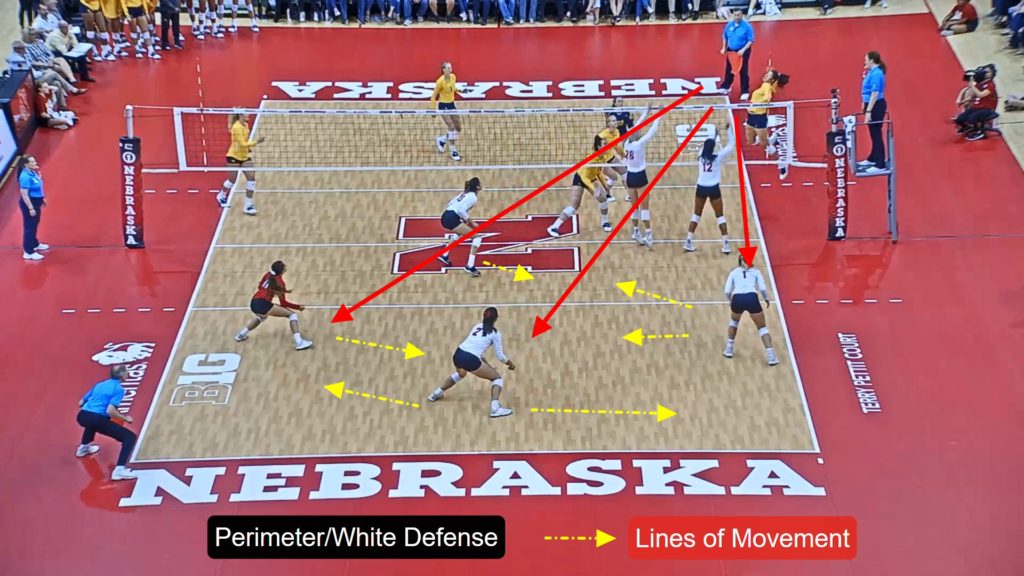
Defensive Court Positioning – In the picture below, we look at a traditional perimeter defense with defenders positioning themselves around the block and assigned court coverage movements. Most high school situations may mandate the coach to be more creative due to the smaller size of the block and the nature of the attack. With a smaller block, the attacker has more court area to direct the attack, mandating greater court coverage in the backrow. Consequently, the focus may not be on positioning around the block, but rather on reading the hitter to position the defender, or on placing your defenders where most of the attacks are directed (behind the block for tips, or in the deep, middle of the court). Sometimes on defense, you give up something to get something. If you position your defense in an area that your opponent is most likely to attack, it doesn’t preclude attacks that score in other areas. You are playing percentages!
Video of the Week – This is a video of the Thailand 11-year-old championship. I was very impressed with the fundamental skills, including passing and approach footwork. These young athletes have received very good skill instruction. It also underscores what young athletes can accomplish with excellent instruction. VIDEO
Archive Blog Post – Good armswing mechanics are crucial for the success of your players in serving and attacking. In this blog post, we look at key aspects of positive throwing mechanics and things to look for as you work with your players. READ MORE
Thanks for reading. Have a great week!
To join the newsletter mailing list, visit the Jim Stone Consulting Homepage (link below).
~Jim
