Three Ideas Newsletter – 8.19.25
The high school and collegiate seasons will get underway soon. I wish all coaches great seasons. Coaching, regardless of the level, can present mental challenges. Coaches must be cognizant of how they evaluate their performance. One of the pitfalls that is always lurking is “recency bias.” We need to avoid the human tendency to evaluate our performance based upon recent events. The match that was lost that should have been won, the unpleasant meeting with a parent, a nasty comment on the internet can play havoc with our mental well-being. Allowing events, whether positive or negative, to affect our self-worth can lead to significant fluctuations in our perception of job performance.
To counter the impact of recency bias, develop a broad perspective on your coaching performance. How is the team trending? The good performances in matches are generally a lagging indicator of positive trends in practice. Reinforce your abilities by recalling moments when you had success and implement positive self-talk (make sure you’re listening to your self-talk!). Focus on non-volleyball activities that bring you enjoyment.
Two ideas worth considering. One, the late North Carolina basketball coach, Dean Smith, would never have team meetings after a poor performance. Emotions might be high, and coaches might say things that aren’t beneficial. He always waited until the next day to evaluate a poor performance. The second suggestion is from Terry Liskevych, former USA National Team Coach. He suggested that occasionally taking a day off after a poor performance was a wise move. Equally, Terry was hesitant to take a day off after a positive performance. Many coaches do the opposite. Terry’s rationale was that after a good performance, the players are excited and will be anxious to keep getting better. Conversely, practicing after a poor performance, one might see a “hangover” from the previous night. I don’t want to suggest you never practice after a poor performance, but if you need to take a day off anyway, that might be good timing to do so.
Quote for the Week: “Any stat that involves such human subjectivity is immediately reduced in value as a result.” ~ Smart Baseball, Keith Law
Idea #1 – Transition Attack for Middle Hitters – Get to Home Base! – Going from blocking to attack requires hard work along with efficient footwork. In this brief video, we demonstrate the footwork needed to go from block to attack. VIDEO
Idea #2 – “Reading The Game is Not Enough” – Without question, the ability to read and anticipate events on the court is an ingredient to being a good player. However, it is not the only ingredient. Even if you are defending an attack and “read” the direction of the attack, you still need to have the skill and movement to dig the ball successfully. For discussion, let’s say that both reading and skill execution are collaborative and of equal importance. At a younger age, understanding the visual cues that allow players to anticipate is essential. For example, if the server faces cross-court, that’s probably the direction of the serve; if the attacker has an open hand on the attack, it will be a tip; if the setter arches her back before setting, it will probably be a backset, etc.
However, at the higher levels, reading becomes more challenging. Experience, combined with skill, allows players to become more adept at disguising their intentions for attack, serve, or set. For example, a jump server may face cross-court on the serve, but contact the serve wrist away and have the ball go down the line; attackers will face in one direction with their shoulders, but attack away from their shoulders; a setter may arch their back, indicative of a backset, but push the ball forward. So, at the higher levels of play, you must work with your players to read the events along with reacting to an unforeseen shot, serve, or set. To read and react requires movement and technical skills that are developed every day in practice. Don’t make the mistake of solely focusing on reading skills while ignoring the foundational skills of movement and skill development that will allow good plays to be made.
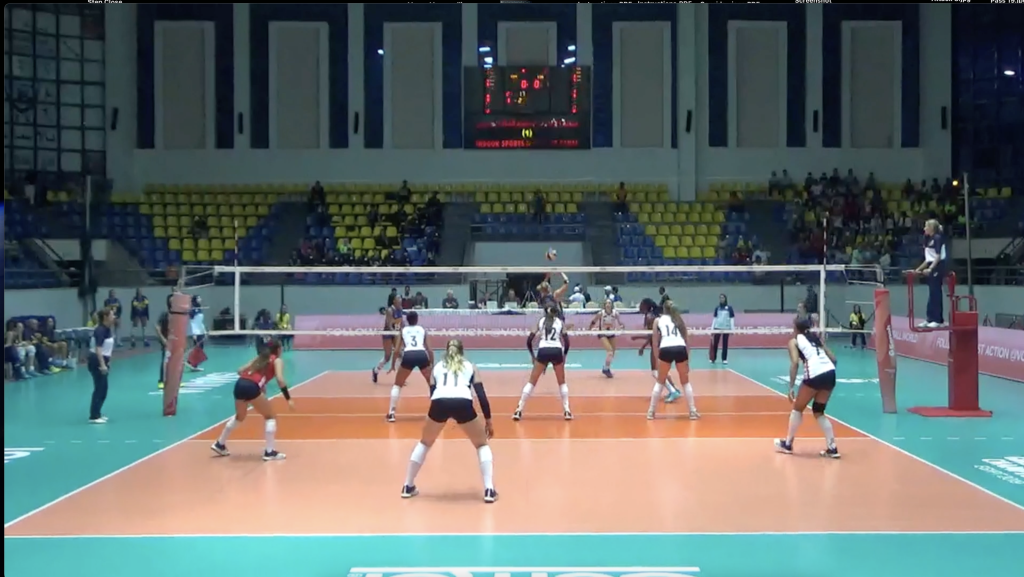
Idea #3 – Blockers-Starting Posture Should Facilitate Lateral Movement – At times, as a player, you give up something to get something. Traditionally, blockers start with their hands at their shoulders, or higher, in preparation for the block. There is nothing inherently wrong with this beginning posture, but consider if most of the sets go to an outside attacker, does this posture facilitate lateral movement to the outside? In the photo below, examine the starting posture for all of the blockers. Their hands are dropped to a lower position that facilitates a faster move to the outside attacker. With the possible exception of a tight pass and a good middle attacker, consider having your blockers start in a position that gets them to the outside attacker as quickly as possible.