Teaching Your Players to Read and React

How often does the disheartened coach mutter, “How did she not see that?” as the off-speed attack bounces just out of the reach of a defender? From early ages, through national team play, the game is being played with increased serve and attack velocities, accelerated blocker movement, and sophisticated offensive and defensive systems. The ability to “read” events becomes more important as the game’s speed accelerates, underscoring the need for improved recognition and anticipation abilities.
Playing against Italian volleyball star Paola Egonu in the 2017 U-18 World Championships demonstrated how much reaction time is stressed when receiving her serve. The time from ball contact on Egonu’s serve to the passing platform of the passer was measured at approximately 0.60 seconds. A passer will take about 0.30 seconds to react to the server’s contact. So, our passers had approximately three-tenths of a second to react and move to pass the serve. It was a challenge, to say the least. This type of velocity in the serve and attack necessitates the ability to read and anticipate the game’s events rather than just reacting to the events.
Reading and anticipating events during live action is not just a physical reaction to visual stimuli or cues. It’s an engaging learning process that allows the player to focus on the relevant visual information while discarding the non-essential information. For instance, if the player is playing right back and defending the left front attacker, here’s the sequence of visual and cognitive events that unfold in milliseconds.
- Recognizing the visual cue: The ball is set to the LF attacker, and the eyes leave the ball and focus on the block and the attacker.
- Detecting relevant cues: there could be multiple relevant cues: 1) the location of the attacker and ball relative to the block; 2) the approach quality by the attacker; 3) the armswing of the attacker indicating a hard or off-speed attack.
- Decision-making – the attacker is tipping the ball over the block. The ball is played by which defender?
- Alteration in attention focus – the eyes leave the opponent and focus on the ball.
- Developing the needed levels of motivation – determination to make the play
- Focus on the result of the action – where am I directing the ball when making the defensive play?
A similar sequence of events will occur in all the facets of the game, such as blocker vs. attacker, passer vs. server, defender vs. attacker, etc. Since anticipating on-court events is not merely a reaction to the events but a cognitive anticipation of upcoming events, how does the athlete develop this thought process?
Studies have shown that reaction time is faster when accompanied by cognitive strategies versus merely reacting to a stimulus.
“We provide novel evidence that reaction time is shorter following a steady anticipatory strategy (cognitive cues) than a dynamic one (reacting without cognitive cues). In conclusion, a steady anticipatory strategy is advantageous for tasks in which the speed of reaction time is essential.” (2)
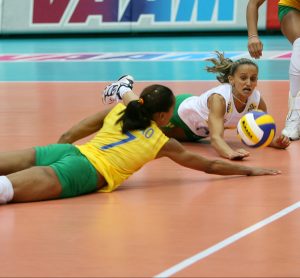
How might coaches assist their athletes in incorporating the cognitive recognition of the available visual cues during live action? The coach’s role in this process is crucial. Many coaches put players into live situations and let them independently figure out the relevant information. Although this strategy will work, there are more efficient learning models than this one. After all, practice time is limited, and the goal is to learn and refine the skills as much as possible during the available time.
Another method, which would be more in line with the above study, would be for the coach to help the athlete determine the relevant vs. irrelevant visual cues. For instance, in a defensive play, the location of the attacker and ball relative to the block would be a relevant visual cue. In contrast, whether the attacker received the serve would be an irrelevant visual cue. There is so much visual information available to the athlete that some assistance in discerning the relevant visual cues would benefit the learning process.
A cautionary note for the coach would be that quickly reading and reacting to a play requires that cognitive information be stored in long-term memory with the goal of rapid recall. An athlete who actively analyzes each play component while the play unfolds will react slower to the play. All essential visual cues must be committed to memory, and quick recall must be rehearsed. How should these visual cues and cognitive recall be best rehearsed? Here are a few ideas:
- Specificity—Make the training as close to game-like as possible. Provide relevant feedback to the athlete when the response to the visual cues is appropriate or inappropriate. An example might be a drill where the attacker must tip 50% of the time, allowing the defense to work on seeing the tip and reacting to the off-speed shot.
- Incorporate If/Then- Work with the player to use “IF/THEN when incorporating visual cues into a reaction. For example, “IF the blocker is late to the outside, THEN I will hit the line.” ‘IF the hitter shows a tip, THEN I move up the line to defend.” The If/Then concept will assist in combining visual cues with movements.
- Verbalize—Have the athlete verbalize what they see (call out “short serve” when the server provides the visual cue).
- Challenge—Make the visual cue challenging for the athlete (e.g., the blocker sets up to block line or crosscourt, and the attacker sees the block location and hits the appropriate shot).
- Quiz the athlete on the appropriate visual cues in various situations.
- For younger players, keep the cues simple and easy to recognize.
- Constantly quiz the players on “what did you see?”
The takeaway is that coaches must prioritize having their players learn the visual cues associated with the various skills. The goal is for the player to build habits based on visual cues and stored cognitive information. If good habits are developed, the movements will be faster. If 70% of reaction time is based on cognitive cues, then the cognitive component of reaction time should be a priority. You still might not be able to react to Oguno’s serve, but you’ll have a better chance!
Sources
