How Journaling Made Me a Better Coach

Much to my detriment, I never kept a journal while coaching collegiately. I mistakenly thought journaling was for nerds or teenagers with loads of angst. Besides, who has the time? The thought of scribbling in a notebook positively impacting my coaching skills was nowhere on my radar. I began to keep a daily journal during my work with the USA U-18 team. I credit my assistant coach, Michelle Chatman-Smith, for getting me started. She had the entire team journaling during the tryouts. The players enjoyed the process of writing and responding to questions. I am grateful for being pulled into the process.
Without hesitation, I would say that the daily process of putting thoughts to paper, creating scenarios, and responding to “what ifs” made me a better coach. The journaling process assisted me in understanding how to think things through – to push my mind past the first step – and helped me solve existing problems while avoiding potential problems and plotting an action plan. Could I have used this tool during the first twenty-five years of coaching? A resounding yes! But such is life looking through the rear-view mirror.
Research has shown a myriad of benefits to daily journaling. I’ll restrict my observations to the potential areas that correlate to coaching.
Facilitate Second-Order Thinking: In his book, The Most Important Thing, author Howard Marks delineates the difference between first and second-order thinking. “First-level thinking is simplistic and superficial, and just about everyone can do it (a bad sign for anything involving an attempt at superiority). All the first-level thinker needs is an opinion about the future, Second-level thinking is deep, complex and convoluted.” — Howard Marks, Investor & Writer.
First-level thinking often results in hurried decisions that are simplistic and intended to show immediate results. These decisions address an immediate concern without consideration for longer-term ramifications. This does not mean that first-level decisions are wrong. However, many decisions do not have to be made hastily.

Conversely, second-order thinking examines the longer-term impact of your decisions. With second-order decision-making, you examine the possible consequences of your decisions. You will find yourself posing the question, “And then what?” as you look at the outcomes of your choices. When a coach incorporates second-level thinking when making decisions, they might consider their own biases, history of similar situations, the possible impact on team chemistry, the potential impact on a player’s confidence level, the coach’s values for the program, etc. Second-level thinking is complex, so many coaches don’t go there.
Going through the writing process of journaling allows you to take a breath, examine the events of the day, the decisions made, or those that need to be made, and examine the scenarios that might result.
An Aid for Decision-Making: Coaches make countless decisions daily. Many of these choices need to be made “on the fly.” These rapid decisions are unavoidable and part of the challenge of our profession. Do I call a timeout or not? Do I make a line-up change? However, some decisions merit deeper reflection. For example, what are the values of my program, and do the daily decisions I make with individual players or the team accurately reflect those values?
Keeping a journal assisted me in making snap decisions in the heat of competition by rehearsing in advance possible scenarios. Equally, thinking deeply about more complex issues assisted me in plotting a path that would serve the team and the program positively.
A Tool to Evaluate Your Coaching: As I journaled, I could evaluate my coaching performance during practice. Was the practice organized with clear objectives? How was the communication and feedback? The practice was not great; how did I handle my frustration? Did the drills accomplish what was intended, or are modifications needed? Is the team performing to expectations? Why or why not? Going through the thinking and writing process allows you to examine your effectiveness as a teacher and motivator. What are the possible ramifications (second-order thinking) if I initiate some changes?
A Tool for Planning: You can format your journal in any manner that meets your needs. Many software tools are available to get you started. I prefer writing my journal by hand on a blank sheet of paper because it is slower and allows me to be more thoughtful. I came across a template that might benefit those of us in coaching. It is titled Plus, Minus, Next and was formatted by Anne-Laure Le Cunff. I did a rough draft of how it might be used for volleyball coaches. You look at a practice and note what was done well (Plus), where expectations were not met (Minus), and based on the first two areas, plan for future activities (Next). It’s very simple, but it might help organize your thoughts.

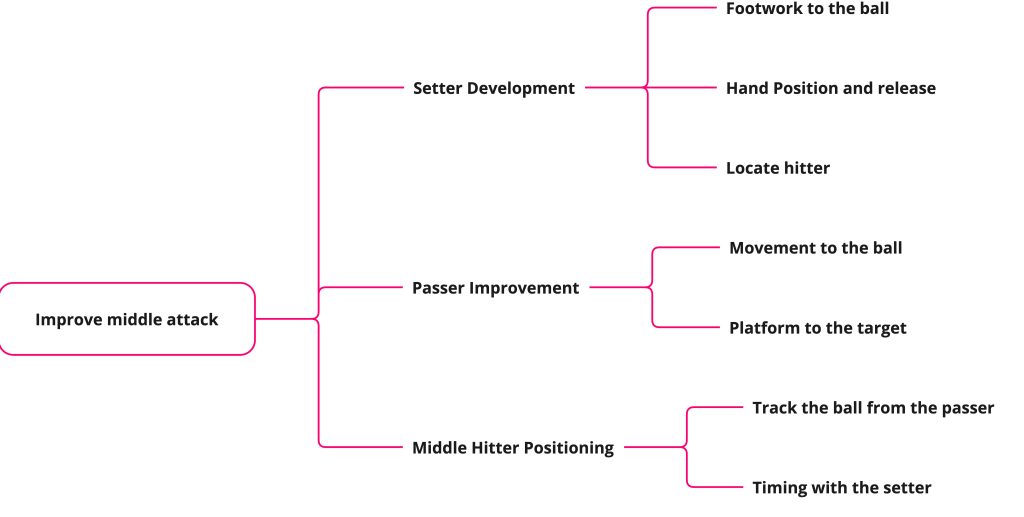
Mind Maps: I will also use journaling to map out the foundational components of a skill or system I want to develop. Below is a simplified sample that shows the end goal of improving the quality and consistency of my middle attack, along with the needed steps to facilitate the desired improvement. I will do this to help in practice planning and provide focus to the players in all the positions, so all the players understand that their skill development is instrumental to achieving the final objective of a better middle attack.
Final Thoughts

After each jump during the competition, Australian Olympic high jumper Nicola McDermott does something unusual. McDermott will rate her performance in discrete categories – take off, run up, jump, and so on – out of 10. She then discusses these assessments with her coach, Matt Horsnell, before choosing a single area of improvement for the next jump. “I do that faithfully following every jump,” she explains. “I’m there with my pen. I never get 10 out of 10 – there is always something to work on. McDermott believes this attention to detail is a primary factor in her development into a world-class jumper.
Although all coaches have busy schedules, taking time for mindful writing about daily events can help you successfully manage the various situations that arise in coaching. Consistency is key; you can write daily, weekly, or bi-weekly based on your preference. However, I have found that daily entries help me connect thoughts and ideas, record observations, and plan for future practices. Incorporating journaling into my coaching routine proved to be a great benefit for me and I highly recommend this practice as a vital component of your coaching toolkit.
